Send Submissions To: inquiries@fourthavenew.com
Under the Neon Light: How Raves Are Rewriting What Partying Means in Nigeria

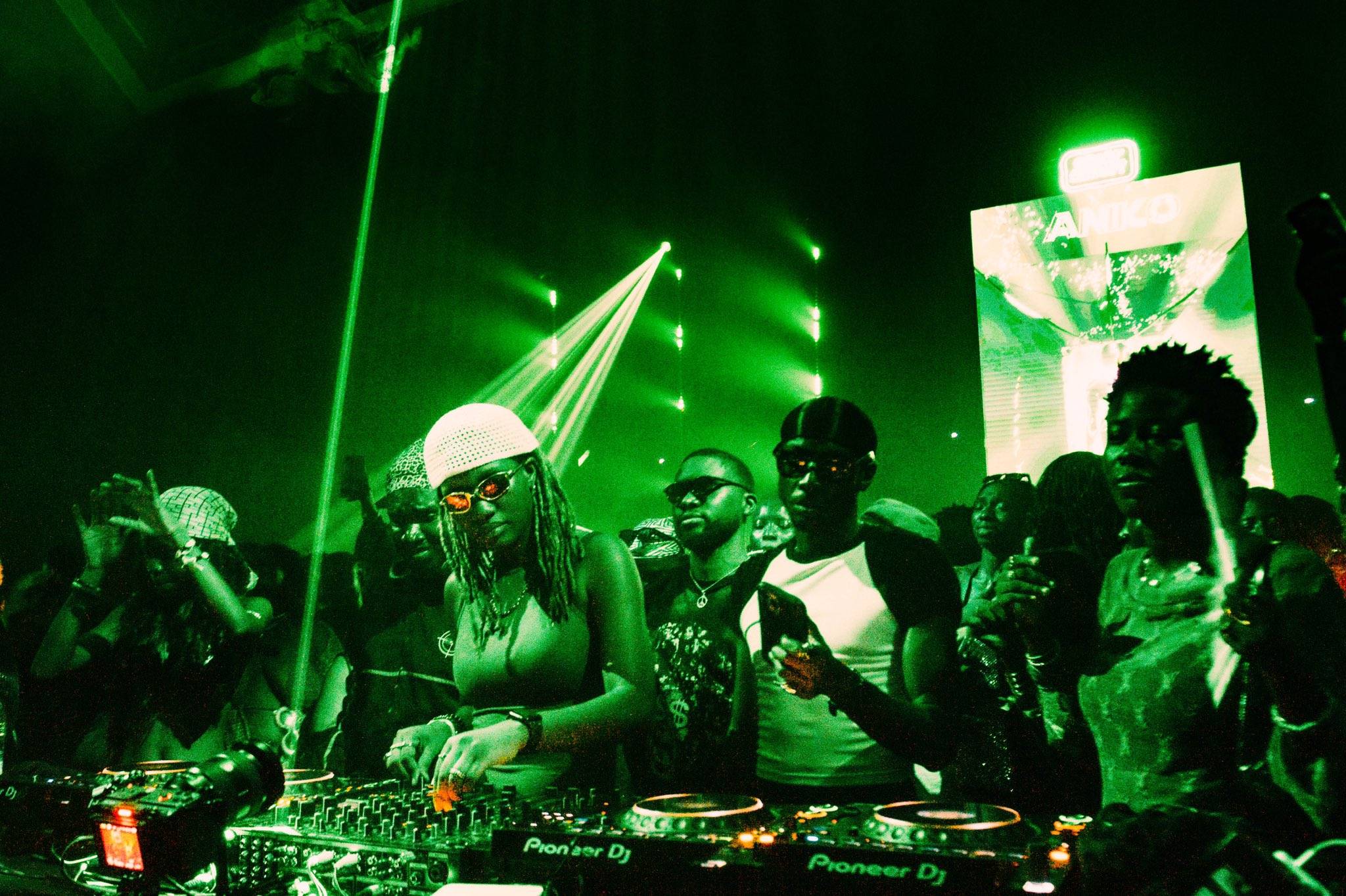
For decades, a night out in Lagos, Nigeria followed the same script; you book a table and buy bottles. The more you spent, the better your spot, and the night quietly turned into a competition over who could spray the most money. Somewhere in all of that, the actual dancing got lost. Everyone acting too matured to loosen up, even when the song was hitting.
However, things are beginning to change.
I walked into a rave party in Lekki last week and the old rules did not apply. There were no tables. There was one small bar with drinks cheaper than any nightclub would dare sell at. The room was dark, broken only by green strobe lights, and bodies moved shoulder to shoulder on a floor that finally exists for its original purpose; dancing. As DJ Aniko, who founded “Group Therapy” put it, “at a regular Lagos party, there is no dance floor.” Raves are bringing the dance floor and the art of dancing at parties back.

This is the shift that is worth paying attention to because it’s not just about music anymore but rather what young Nigerians are reaching for. There’s an economic story underneath this. Amid skyrocketing inflation, the table-and-bottle model has priced an entire generation out of nightlife. You can’t perform wealth you don’t have. So a scene built on not performing it, no VIP, no sections, no aura farming, wasn’t just refreshing but also the only door left open.
Money is only half of it. The bigger pull is something harder to name. People want somewhere to feel safe enough to be themselves. In a society as conservative as Nigeria’s, that’s not a small thing to offer. The rave has become the rare space where nobody is keeping score of who you are. One friend put it simply, “The beauty is the setting.” No tables, no bottle service, no VIP. You go there to dance. You get lost under the neon light. Big wave starters like The Element House, Group Therapy have built this space with over eleven editions and counting, while others like Sunday Service and Ilé Ijó are building more.
What makes this a movement and not a single hot party is that it is happening in several places at once, in several sounds. The names have multiplied from Group Therapy to Element House, Ilé Ijó and Sunday Service, with each one opening a different door.
Group Therapy leans towards the house music genre. Its founder, DJ Aniko, didn’t even call it a party, she called it “therapy,” and runs it as a deliberate, recurring ritual built for collective release rather than spectacle. Ilé Ijó runs faster and harder: a drum-and-bass community built around dancing at 160 BPM and up, the kind of night where the instruction is literally “bring your USB.” Others sit somewhere in between but the point is, a dozen different crowds chasing a dozen different sounds have all arrived at the same idea to strip out the hierarchy and keep the dance floor. The scene isn’t one genre wearing one outfit, but rather a widening room with many doors.
The resistance is real, and it usually sounds the same with rhetoric like: “Raves are gay.” “Why would I watch men dance near other men? I could never.” That’s the thing the scene does though, it disarms you. House music, as one attendee put it, “evokes feelings,” that gets you to connect to the music, as well as everyone else connecting to it. People walk in braces for something to judge and walk out having forgotten they came to judge at all. They came looking for a party, a lot of them found therapy.
It would be dishonest to write about this culture without saying plainly who built and held it. For queer Nigerians, the rave is their event, one of the few spaces in the country where they aren’t watched, judged, or made to shrink. The inclusivity everyone now celebrates didn’t appear from nowhere. It was carved out by people who needed it most, and the rest of the city is now being let in on something they made.
And the organizers don’t leave it to chance. Ilé Ijó states the terms on its own flyers, “this is a space for everybody; homophobia, transphobia, misogyny and ableism mean immediate removal, no warnings; consent is everything ask before you touch, dance with, or photograph anyone.” Safety isn’t a vibe people hope for, it’s a rule the community enforces. That’s worth sitting with, especially as the scene grows.
Musically, this is a genuine crossover moment. Since around 2022, after the post-pandemic wave of South African genres, Lagos DJs have been folding African elements into house, part of the same lineage that gave us amapiano. EDM and electronic music, which were once treated as foreign, are finding Nigerian ears, and increasingly Nigerian fingerprints, as these sounds start bleeding into Afrobeats itself. Aniko frames where it’s heading without hesitation, “the scene is now inside a wider global ecosystem rather than on its margins. International DJs are flying into Lagos; Nigerian artists are moving outward. The future people imagine is simply more of this, more genres, more diversity, more inclusivity. A wider sonic palette for a wider room.”

No honest portrait of this skips the cost. A rave is, as one friend said, a very accepting community and acceptance has edges. The same openness that lets people be free also makes room for everything else; the drink, the vices, everything nobody is judging. That’s the beauty and the danger in the same breath, like a double-edged sword.
There’s also a quieter risk. The deeper you sink into the community, the easier it becomes to lose pieces of yourself in it, almost like an initiation, one friend warned. There’s also saturation. As “rave” becomes a buzzword, people show up for the label rather than the spirit, and the close-knit thing that made it special starts to thin out. The hype men the scene was built to escape are already looking for ways back in.
Still, something real is happening. Raves are kicking back against the rot that ate into Nigerian nightlife, the spraying, the spending, the performance and offering dancing for its own sake again. Port Harcourt has adopted it, Abuja is catching on, and it is spreading because it answers a need the clubs stopped meeting. The need to not be seen, but to feel free.
So here’s the honest take. If you want to genuinely lose yourself on a dance floor maybe even fall in love on one, go to a rave. The music will make you forget, and for a few hours, it might even heal you.
Just remember that freedom, like the neon light, is something you walk into with your eyes open.
Written by: Jane Ugwu